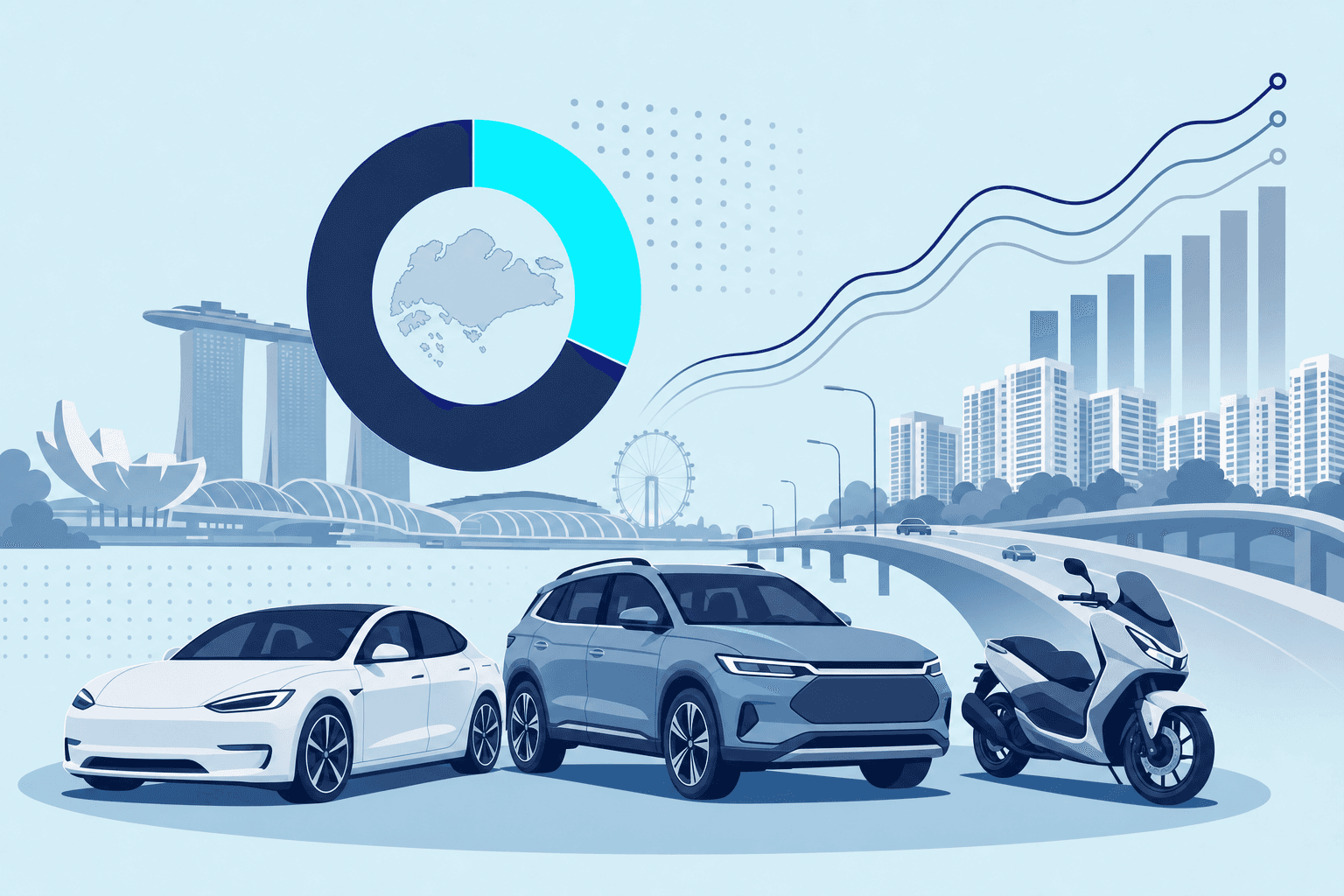
Singapore car market hits a major milestone in April 2026 as electric vehicles capture over 65% of new registrations. Led by BYD, the shift toward sustainable transport is accelerating, with SUVs remaining the most popular body type among local buyers.
- 65.50%
- Electric Vehicle Share
- 2,982 units registered in April
- 1,400
- BYD Dominance
- Single-handedly capturing 31% of the market
- 63.30%
- SUV Popularity
- Remains the most popular vehicle body type
- 4,553
- Total Registrations
- A robust month for the Singapore car market
Executive Summary
April 2026 marks a transformative period for the Singapore automotive landscape, characterized by an overwhelming shift toward electric mobility. Electric Vehicles (EVs) now account for nearly two-thirds of all new registrations, signaling that the nation's "Green Plan 2030" is well ahead of schedule. While total registrations reached 4,553 units, the decline of traditional internal combustion engines is now undeniable, with petrol cars making up just 5% of the monthly total.
Fuel Type Breakdown
| Fuel Type | Total Registrations | Percentage |
|---|---|---|
| Electric | 2,982 | 65.50% |
| Petrol-Electric | 1,243 | 27.30% |
| Petrol | 230 | 5.05% |
| Petrol-Electric (Plug-In) | 97 | 2.13% |
| Diesel | 1 | 0.02% |
| Total | 4,553 | 100.00% |
Vehicle Type Breakdown
| Vehicle Type | Total Registrations | Percentage |
|---|---|---|
| Sports Utility Vehicle | 2,882 | 63.30% |
| Multi-purpose Vehicle | 733 | 16.10% |
| Sedan | 727 | 15.97% |
| Hatchback | 136 | 2.99% |
| Coupe/Convertible | 57 | 1.25% |
| Station-wagon | 18 | 0.40% |
| Total | 4,553 | 100.00% |
Detailed Analysis
Fuel Type Trends: The EV Takeover
The most striking takeaway from the April 2026 data is the complete dominance of Electric Vehicles (EVs), which captured 65.50% of the market with 2,982 units. When combined with Petrol-Electric hybrids (27.30%) and Plug-in Hybrids (2.13%), over 94% of all new cars registered in Singapore now feature some form of electrification. This trend suggests that charging infrastructure and government incentives, such as the EV Early Adoption Incentive (EEAI) and the VES scheme, have successfully mitigated previous concerns regarding range anxiety and upfront costs.
Popular Makes and Models
BYD continues its reign as Singapore's top-performing brand, registering a massive 1,400 units in April alone—nearly 31% of the total market share. The Chinese manufacturer's success is largely driven by its comprehensive EV lineup, particularly in the SUV and Sedan categories. Toyota holds the second spot with 427 units, though notably, the bulk of their volume remains in the hybrid (Petrol-Electric) segment rather than pure electric.
European mainstays Mercedes-Benz (291) and BMW (287) are locked in a tight race for third, while newer Chinese entrants like GAC (214), Chery (200), and Zeekr (156) are rapidly climbing the ranks, displacing established Japanese brands like Honda in the process.
Vehicle Type Preferences: The SUV Era
The preference for Sports Utility Vehicles (SUVs) shows no signs of waning. With 2,882 registrations, SUVs command 63.30% of the market. This body type has become the standard choice for families and commuters alike, offering the perceived versatility and road presence that Singaporean buyers currently value most. Interestingly, Multi-purpose Vehicles (MPVs) at 16.10% have narrowly overtaken Sedans (15.97%) for the second spot, likely fueled by the high demand for electric private hire vehicles and larger family transporters like the BYD M3 and Toyota Noah/Alphard hybrids.
Market Implications
For Prospective Buyers
For buyers, the message is clear: the future is electric. With petrol vehicles becoming a niche category, resale values for internal combustion engine (ICE) cars may face increased pressure in the coming years. Buyers should focus on EV models with high charging efficiency to future-proof their purchase.
For the Automotive Industry
Dealerships must pivot rapidly to service and support electrified fleets. The strong performance of Chinese brands indicates a shift in consumer perception, where technology and software integration are becoming as important as traditional brand heritage.
Environmental Goals
Singapore is well on its way to meeting its goal of phasing out ICE vehicles. The high adoption rate of EVs in April 2026 suggests that the city-state is successfully transforming into a living lab for sustainable urban mobility, providing a blueprint for other metropolitan areas globally.